Fermentieren
9. May 2025Read more

10. April 2026
For a food to be perceived as a complete success, it must score highly in far more areas than just taste. As the well-known saying goes, ‘you eat with your eyes’ – but texture is at least as important. Whilst expectations regarding texture often begin the moment you first lay eyes on a dish, they also encompass the sensation in the mouth and the experience whilst chewing. For food producers and catering businesses, texture and texture analysis are key elements in the journey towards creating recognisable foods that meet the needs of their target audience. This blog article explores the importance of smooth textures, the ‘crunch factor’ and more.
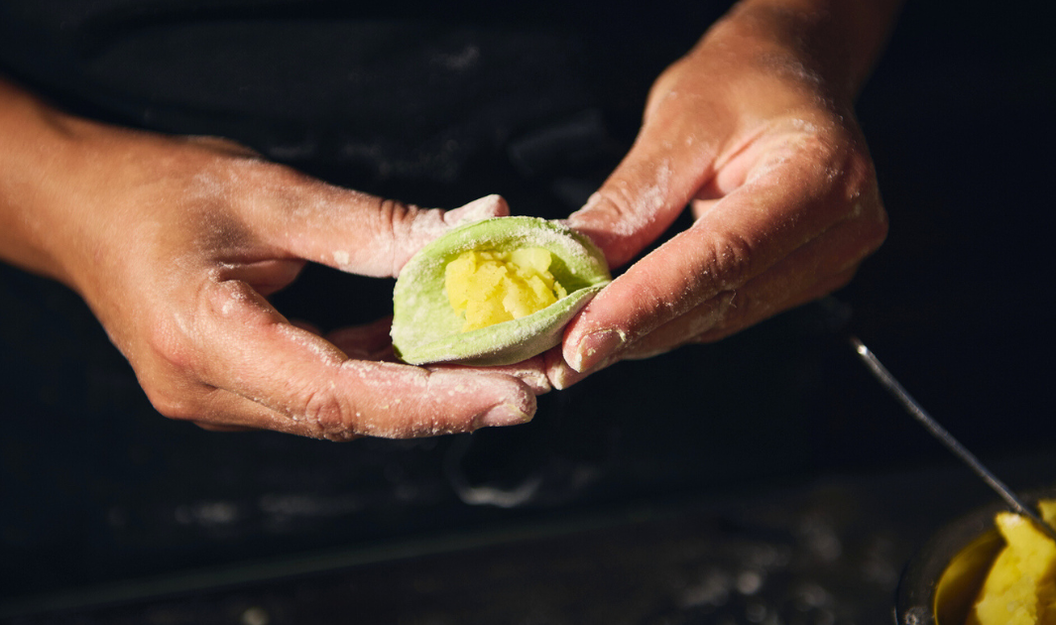
There are a great many different textures, which in turn depend on various factors. In this country, the following are among those commonly found:
Creamy, light and soft textures, such as those found in soups, dips, fillings and certain desserts like the Soufflé
Crispy textures, like those found in fresh vegetables, bockwurst sausages or certain snacks
Crispy surfaces that are particularly noticeable when you take a bite, as with crispy Breadcrumb coatings or bread rolls
Firm and compact textures, such as those found in Leberkäse, sausage, cheese or some baked goods
Elastic structures with a noticeable elasticity, such as that found in dough or certain sweets, for example marshmallows
Juicy, tender or fibrous textures, such as those found in meat or fish
Smooth products such as yoghurt or purées, gel-like products such as jelly, and foamy products such as mousse or whipped dessert creams.
Of course, a foodstuff can have different textures at the same time. A breaded Schnitzel For example, it is as crisp as possible on the outside and tender on the inside. Or a light, flaky croissant filled with cream. The various possible combinations make the subject all the more exciting.
Texture is essentially a multi-sensory concept. It plays a key role in determining whether we find a food product appealing and of high quality, and whether we enjoy its taste. Visual appearance and past experience create certain expectations that also relate to consistency and texture: Crisps should be crispy, chocolates should melt in the mouth, yoghurt should be creamy, salad should be crunchy, and meat should be tender and juicy. If this is not the case, it generally detracts from the overall impression – even if the flavour itself is very good.
A consistent texture depends on various factors, starting with the selection of high-quality and, where appropriate, fresh raw materials. Equally crucial are carefully considered recipes tailored to these ingredients and meticulous processing. For example, the distribution of moisture, or the type and intensity of mixing or kneading, have a major influence on the uniformity of the final product. The fat content, egg white structure and the binding agents used are also crucial. Last but not least, the processing stage depends on the cooking time, the baking process, cooling and storage, as well as the packaging.
The importance of this is evident, for example, in the production of plant-based Meat alternatives. The desired texture should be as close as possible to that of meat – in other words, juicy and tender. However, plant-based proteins, fibres and the like generally behave differently from those found in animal products. Developing a suitable meat substitute therefore requires expertise in formulation, processes and equipment.
As texture is a multisensory experience, it begins when we see, touch, cut or plate up the food. It is only when eating that the sensations experienced by the lips, tongue, teeth, palate and jaw come into play. This is when temperature, pressure, resistance, how it breaks and, for example, juiciness are registered. Another sense involved in human texture analysis is hearing – which, for example, enhances the impression of a crisp texture. This, in turn, is associated with freshness or a successful cooking process, whilst creaminess is often linked to a full-bodied flavour and enjoyment. If food is excessively sticky, many people associate this with an imbalance or a technical fault in the production process.
Whether a texture is perceived as pleasant depends not only on expectations but also, to a large extent, on cultural influences. Furthermore, the target group is a key factor: young children and people with difficulty chewing or swallowing sometimes need soft textures.
So it is not just how something tastes that matters, but also how it feels, how easy it is to chew and the sensation it leaves in the mouth. Precisely because texture plays such an important role, it should be taken into account during product development. There are various texture analysis instruments available which can be used to assess characteristics such as stickiness, chewability, firmness, crunchiness, crispness, elasticity, brittleness, extensibility, hardness and breaking strength. This can be an effective means of quality control, particularly in large-scale production where the aim is to deliver a product that is as consistent as possible across many batches. Based on the results of the texture analysis, targeted adjustments can be made subsequently.
As professional suppliers to the food production and processing industry, we understand the challenge of achieving the perfect texture – and meet this challenge with a tailored range of products. From mixers for thorough blending, through binding agents, to suitable packaging and workwear, we stock everything needed for hygienic and high-standard production.


More articles