Ratgeber zur Herstellung von Fischkonserven
9. December 2022Read more

The temperature of food is influenced by numerous factors. It affects a food’s shelf life and microbial safety, as well as its texture and processability. Regular temperature checks are therefore important not only for meat, fish and poultry, dairy and frozen products, but also, for example, when serving soups and sauces. The temperature profile over time can also be crucial, for example during heating, cooling, storage or transport. For this reason, a wide range of different temperature-measuring devices is available for professional food processing. We take a look at various aspects of temperature measurement within professional food production.
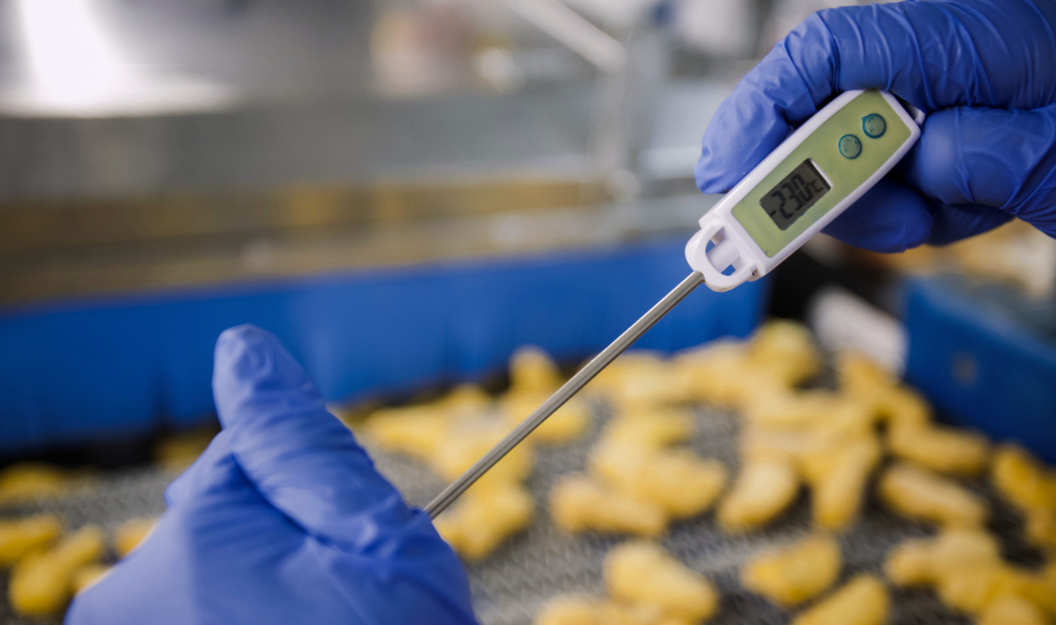
Reliable temperature monitoring and control help to ensure safe processing conditions and are a key factor in limiting the growth of undesirable micro-organisms. Many bacteria find suitable growth conditions particularly in the mid-temperature range, which is why these ranges should be passed through quickly, for example when cooling heated food. Conversely, during specified heating processes, food must reach the temperatures intended for the respective product. Legal requirements, as well as product-specific specifications and guidelines, form the basis for correct temperature control. The DIN 10508 standard, amongst others, provides important technical guidance.
As well as food safety, temperature measurements are an important tool for general quality assurance. Controlled temperature ranges help to ensure that desired product characteristics can be reproduced and that goods are supplied to a consistent standard.
The key tasks involved in temperature controls within a business therefore include, for example:
Monitoring the cold chain
Monitoring of storage and transport conditions
Monitoring of cooking processes
Checking heated food whilst it is cooling
Control of temperature-dependent processing steps
Support from HACCP concepts, self-monitoring and documentation
Reducing quality issues and complaints
The applicable temperature specifications and the measuring instruments to be used are determined on the basis of product- and process-specific assessments. In addition to statutory requirements, manufacturers’ specifications, specific guidelines or internal company guidelines may play a decisive role in this regard.
Temperature checks can be carried out at various stages throughout the entire operational process chain – from the delivery of raw materials, through storage and processing, to the dispensing or dispatch of goods. The point at which measurements are taken depends on the foodstuff, the specific processing involved and the control measures in place.
Checks at the goods-in department are carried out, for example, on chilled or frozen goods and finished products. Depending on the product and packaging, surface temperature measurements may be taken, or, for greater accuracy, using penetration thermometers.
Temperature checks are also necessary during processing, for example for dough, sausage meat, fillings, sauces or related intermediate products. The measured values are used to verify that predefined processes are being reliably adhered to. Depending on the product and the stage of processing, the product temperature or core temperature is a key control parameter.
Temperatures are also monitored during packaging and dispatch, in transport containers or refrigerated vehicles. In the catering sector, communal catering and commercial kitchens, there are further monitoring points during serving, the Keep warm or to the preparation of ready-made meals.
The choice of the appropriate measuring instrument depends on what is to be measured, where, and over what period of time. In professional food production, for example, the following measuring instruments are used:
The thermometers are designed for contactless measurement of surface temperature. They can, for example, assist with rapid checks on incoming goods. To ensure reliable results, factors such as the specified measurement distance, the size of the measurement field and the nature of the surface must be taken into account.
Penetration thermometers are inserted into food to measure its internal temperature. Depending on the application, compact penetration thermometers, folding thermometers with both infrared and penetration measurement capabilities, and measuring devices with interchangeable temperature probes are available. To ensure the equipment is perfectly suited to the task, a range of probe lengths, diameters and probe tips can be selected.
Temperature sensors form the actual measuring probe. They can be permanently integrated into a thermometer or connected to a separate measuring instrument or data logger. Specialised insertion, immersion, surface or frozen food sensors can thus be specifically adapted to different measurement tasks. Immersion sensors are suitable for measuring the temperature of liquid or semi-liquid media. Whether an immersion or penetration sensor is suitable for the intended purpose depends on various factors. Key considerations include the manufacturer’s specifications, the permissible temperature range, the material, resistance to the respective medium and the required insertion or immersion depth.
Cold room or freezer thermometers are used to display the temperature in storage areas, whilst vessel thermometers are generally used to monitor the temperature in containers holding liquids or other suitable substances. Probe thermometers with long cables, such as roasting thermometers, are suitable for taking precise measurements in hard-to-reach places or for displaying temperatures during cooking and heating over a longer period of time. Depending on the design, the probes can remain at the intended measuring point, whilst the display is located outside the container or oven.
Data loggers automatically record temperatures over periods of time. They are therefore particularly suitable for cold stores, storage areas, vehicles or transport containers. However, they cannot automatically replace spot measurements taken directly on the product. Data loggers measure the temperature at the location of their sensor.
Temperature indicators such as pop-up timers indicate that a set temperature has been reached. However, they do not provide easily readable measurements or a continuous temperature record like data loggers do.
Errors can arise, for example, if only the room temperature is measured, even though the product temperature is required for the assessment. Furthermore, an infrared thermometer must not be used to determine the core temperature. Similarly, an incorrectly or inadequately positioned probe on a pen-type thermometer can lead to inaccurate temperature readings. Furthermore, unsuitable, damaged or inadequately tested measuring instruments can lead to incorrect results. Temperature measuring instruments should therefore be checked regularly to ensure they are in good working order, in accordance with the operational control plan and the manufacturer’s specifications.
A probe thermometer that comes into direct contact with food must not transfer any contaminants between products or operational areas. Such measuring instruments must therefore be cleaned and – where necessary – disinfected in accordance with the establishment’s hygiene plan when in use.
Temperature measurement is effective when the process, measurement point, measurement method and specifications are properly coordinated. Reliable, high-quality measuring instruments play a vital role in this. Our product range includes various thermometers, temperature sensors and data loggers for professional temperature control in the food industry. If you have any questions about which product to choose, we’d be happy to offer you advice based on our experience.


More articles