Koriander
7. February 2025Read more

7. August 2026
Food hygiene does not begin with the processing of raw materials, but rather the moment you enter the workplace – wearing suitable workwear. In food-processing plants, commercial kitchens, butchers’ shops, bakeries, laboratories and other establishments, the entrance area is crucial to the cleanliness of the working environment. Disinfection mats are a key component in maintaining high hygiene standards. As part of an effective hygiene programme, they help to reduce the spread of germs and potential contamination via shoes or the castors of trolleys.
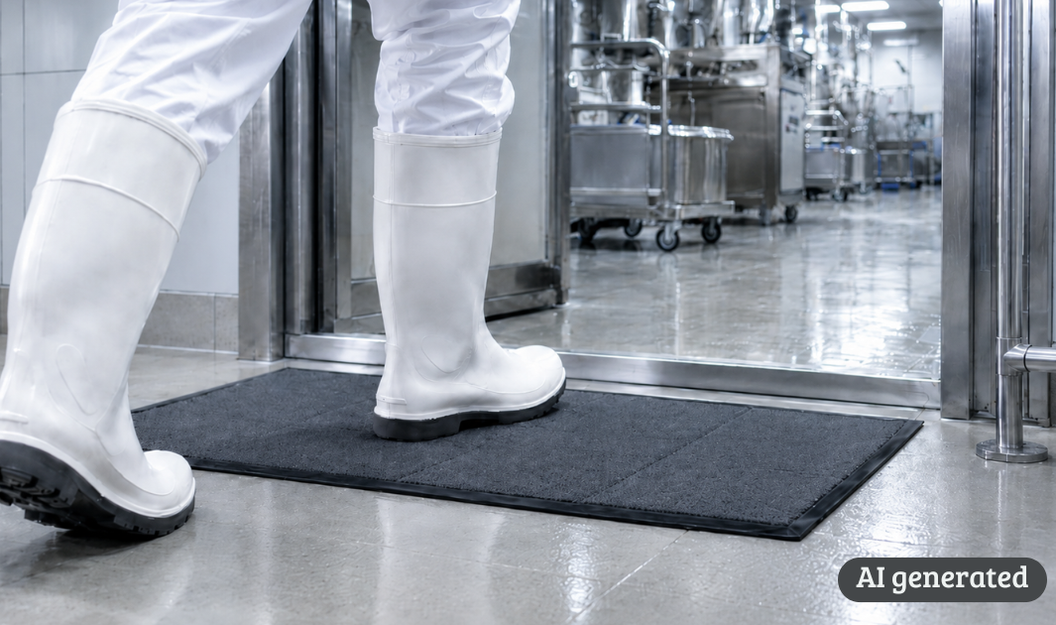
Disinfectant mats are special floor mats which are placed, for example, in the entrance areas of food production facilities. They are filled with or soaked in disinfectant or a suitable disinfectant liquid. When staff enter the area, the pressure they exert causes the mat to transfer disinfectant to the soles of their shoes. This coating reduces the bacterial load on work shoes, boots or other footwear relevant to hygiene.
Disinfection mats come in various designs. They are often made from durable plastics, foam or non-woven layers, and feature liquid-tight edges and bases. There are also differences in terms of suitability and intended use. Some models are intended exclusively for people or footwear, whilst others are also designed to withstand the weight of pallet trucks or roll containers. The risk of tripping can be reduced by recessing the mat into a floor recess.
The mat’s disinfecting effect is triggered upon contact with the sole of the shoe: stepping on it generates the necessary pressure to release the disinfectant. Whilst some of the disinfectant remains on the shoe, the rest seeps back into the mat. To ensure effective disinfection, the contact time is also important – if you walk quickly across the mat, sufficient disinfection often does not take place.
Another crucial factor is the condition of the shoes when stepping onto the mat. The soles of the shoes should be as free as possible from coarse dirt at this point. Various organic residues can impair the effectiveness of the disinfectant. For this reason, the same principle applies here: clean first, then disinfect.
Disinfection mats are most effective when positioned strategically. Suitable locations can be found wherever there are hygiene checkpoints. These include, for example, the entrances to production rooms, cold stores, packaging areas, hygiene rooms or sensitive processing areas. They should be positioned so that people are compelled to step onto the mat, and be large enough to ensure that the shoes are completely covered. In entrance areas through which many people pass every day, it may be advisable to use longer models or to arrange several mats in a row.
The benefits of disinfection mats are particularly evident where hygiene zones need to be separated from one another. These include the following:
Quick set-up and integration into walking routes – whether temporary or permanent
Flexible placement without the need for structural alterations
Simple staff training and a ‘reminder’ function regarding cleanliness
Reducing the spread of germs via the soles of shoes
Hygiene barriers at entry points
Support from HACCP- and self-monitoring schemes
For use in commercial kitchens, food production facilities, storage areas and laboratories
Depending on the model, also suitable for transport routes using pallet trucks
Particularly in workplaces where staff regularly move between the warehouse, production area, cold store or other areas, disinfection mats help to make hygiene rules visible, tangible and easy to follow in day-to-day working life.
Choosing the right disinfection mat depends on a number of factors. For small entrance areas, a compact mat may be sufficient. For commercial kitchens, production facilities or high-traffic access points, larger and more robust disinfection mats are generally the better option. If the mat is to be driven over by pallet trucks or roll containers, it should be specifically designed for this purpose.
In this context, size, material, edge height, filling capacity, ease of cleaning, slip resistance, chemical resistance and position within the walkway play a crucial role. The disinfectant used to fill the mats should also be chosen with care. The aim is for it to disinfect effectively without damaging the mat or the materials of the shoes. Documentation is required here to take into account not only consumption but also factors such as soiling and evaporation.
Disinfectant mats are only effective if they are kept hygienic and sufficiently replenished – otherwise, they can actually become a hygiene risk in their own right.
Proper care includes:
Regular visual inspection for dirt, damage and fluid level
Cleaning the mat in accordance with the established cleaning schedule and whenever it is clearly soiled
Replacement of the disinfectant in accordance with the manufacturer’s instructions
Monitoring the dosage and concentration of the agent
Documentation in the hygiene or HACCP plan
Replacement of damaged or porous mats
There are special drying racks available for freshly cleaned mats, which make the cleaning process even easier.
Even with proper care, it is important to bear in mind that the mats need to be replaced regularly. Please refer to the relevant product recommendations for further guidance.
During food or premises inspections, inspectors check not only whether a disinfection mat is present, but also whether it is integrated effectively, adequately maintained and subject to verifiable monitoring. High-quality products such as the MM Disinfection Mats™ available from our shop have been tested by the BVLK (Federal Association of Food Inspectors of Germany) and are recommended, when used correctly and in accordance with regulations, to ensure food safety and optimise basic hygiene.
When used correctly, disinfectant mats can effectively support hygiene in the workplace. If they are heavily soiled or dried out, they cannot fulfil their purpose. The same applies if an unsuitable disinfectant is used. If the mats release too much liquid, they can also cause wet floors, increasing the risk of slipping. Last but not least, the risk of tripping over the edges must be taken into account.
It is also important to bear in mind that they should only be regarded as part of a comprehensive hygiene strategy and must be supported by further measures in many areas. In sensitive areas, a comprehensive hygiene checkpoint, appropriate workwear, boot washers and other measures are required.
Every successful food production process is based on a combination of comprehensive expertise, high-quality raw materials, functional equipment and reliable hygiene standards. As a manufacturer, Gustav Ehlert GmbH is here to support you: discover our useful appliances and machines, our flavourful spices and other equipment, all of which are perfectly tailored to the needs of the food industry. True to our motto: ‘A systematic approach to enjoyment’.

More articles