Messer: Überblick zu den Schneidewerkzeugen in der Lebensmittelproduktion
8. December 2023Read more

7. February 2025
Some love it, others do their utmost to avoid it: coriander. Coriander seeds have a way of dividing opinions and tastes, but why is that? This blog article reveals all about the plant’s distinctive flavour, how it’s grown and used, and its health benefits. A closer look at coriander – from root to leaves.

To shed light on the early history of coriander seed use, we need to look back quite a long way. This is because Coriandrum sativum, as it is known by its scientific name, belongs to the umbellifer family and is regarded as one of the world’s oldest medicinal plants. Its origins are traced to the Mediterranean region and the Middle East – though it is now found all over the world. It is even mentioned in the Bible, and excavations of ancient burial sites have also uncovered coriander seeds.
So this is by no means just a passing fad. For thousands of years, coriander seeds have been used to enhance a variety of dishes – particularly in Asian cuisine. However, thanks to its immense versatility, this spice is also widely used in other cuisines.
Whether you like the taste or not, you have to hand it to coriander: it can be used in a wide variety of ways. The whole plant, from the root right up to the coriander leaves, can be used. Here are a few examples:
Pages: Fresh coriander leaves can be used as a garnish or as an ingredient in salads, as well as in hot dishes such as sauces. Here, their unique flavour adds a special touch.
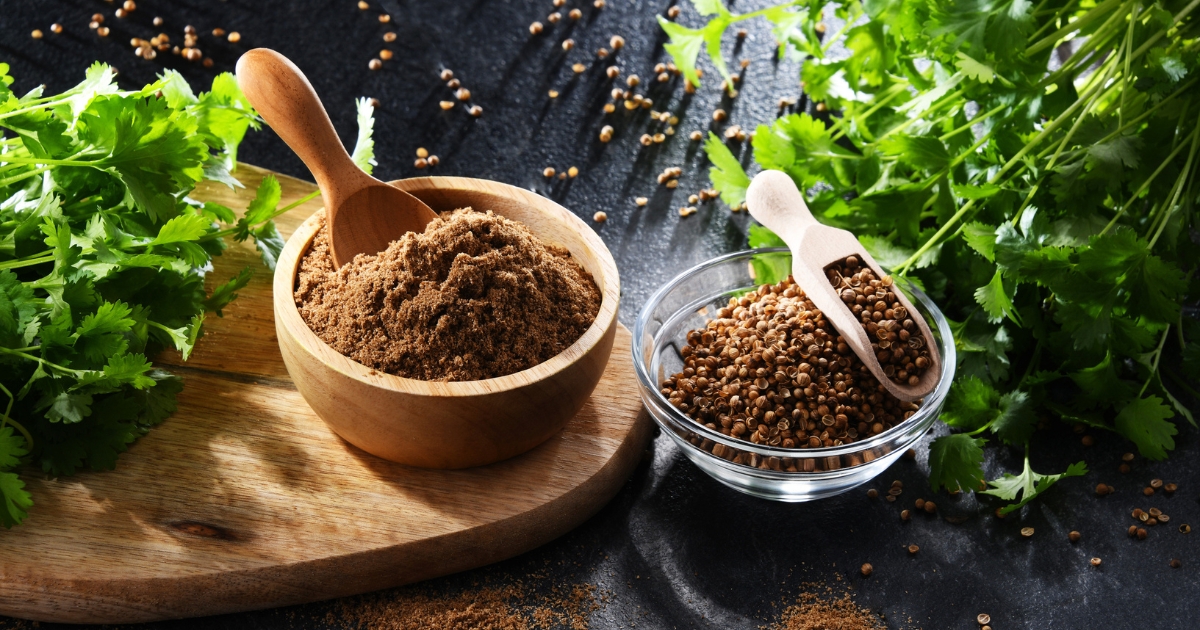
Seeds and fruits: When coriander seeds and fruits are dried – and, if desired, roasted as well – they develop a spicy, nutty flavour. This is often used in various spice mixes or as The spice of the Advent season used for Christmas biscuits.
Origins: Here, it isn’t one of the most popular parts of the plant, but in Thai cuisine, for example, it is just as sought-after and popular in curries.
Coriander therefore stands out for its versatility – and that’s not its only advantage.
Aside from its taste – which can be either a reason for or against eating coriander regularly – the plant offers a number of health benefits. It contains essential oils and, in particular, coriander leaves are rich in vitamins, iron and potassium. It can therefore help with digestive problems and has an antispasmodic effect. As it is also said to have anti-inflammatory properties, it is used in teas, extracts and, beyond the food sector, in ointments. Thanks to its antibacterial and soothing properties, coriander is also used to treat conditions such as high blood sugar levels in diabetes, high blood pressure and insomnia.
One could take the easy way out and simply put it down to the fact that tastes differ. This does indeed play a part in solving the mystery, but there are other explanations as to why coriander is viewed so differently. Research has shown, for instance, that the olfactory receptor OR6A2 determines whether or not one associates the aldehydes in coriander with the smell of soap. Incidentally, the aldehydes are in fact the same as those found in soap. If this is the case, it is a natural protective response by the body to reject the food in question.
Furthermore, the culture – or rather, the prevalence of coriander – within one’s own (culinary) culture plays a role. If coriander is commonly eaten in one’s social circle, the proportion of people who dislike it decreases. Even those who hate coriander may therefore be persuaded to change their minds if given a second or third chance.
Incidentally, the smell of the fresh plant and of unripe coriander seeds can further reinforce some people’s aversion to it. To some, it is reminiscent of a bedbug-like stench. For this reason, coriander is also nicknamed ‘bedbug herb’ or ‘bedbug dill’.
Whether in a domestic or industrial context, coriander seeds and other parts of the plant are frequently used to create unique and intense flavours. This applies equally to the production of curry powders and bread seasonings, as well as to the production of sausages and meat products. Even drinks such as gin and beer benefit from the lemony aroma.
If you’re looking to expand your range with the delicate flavours of Coriandrum sativum, Gustav Ehlert GmbH is the place for you. Not only do we offer a selection of coriander varieties, but also in combination with salt, but also many other spices. As well as parsley, which looks very similar, and strong-flavoured thyme, there’s plenty to discover.
There are also other useful features: starting with practical Dosing & spice scoops …right through to mixing equipment and containers for hygienic storage. With us, you’re perfectly equipped to ensure flawless production. That’s what Ehlert stands for – right from the start.


More articles