Ratgeber zur Herstellung von Fischkonserven
9. December 2022Read more

4. September 2026
Food production and the catering industry without transport crates and reusable containers? Unthinkable. When transporting raw materials and finished products, as well as during their storage and dispatch, these crates are in constant use – and come into contact not only with food, but also with hands, work surfaces and vehicles. For this reason, systematic container cleaning is an integral part of operational hygiene management and supports the implementation of the HACCP scheme. Find out more about cleaning these heavily used crates in this blog article.
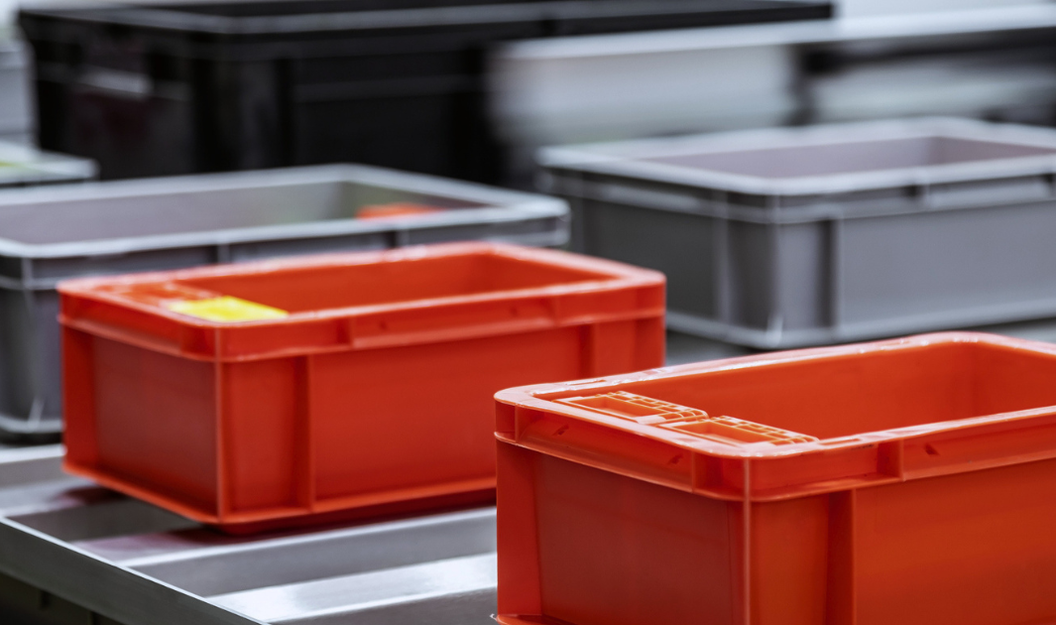
Many areas of food production and processing rely on reusable containers and transport crates. In butcher’s shops and in sausage production, for example, reusable crates are used to transport cuts of meat, sausages or packaged products. Bakeries frequently use the crates for dough pieces, loaves and pastries, whilst in fruit and vegetable processing they are used to transport harvested produce, cut goods or ingredients. They are also widely used in dairies, commercial kitchens, catering, the production of delicatessen goods and for internal order picking.
Stackable containers, in particular, are a key component of standardised goods flows. Thanks to their uniform or coordinated dimensions and sturdy stacking edges, they can be stacked, stored and transported safely. This can significantly simplify the logistics process. When using them, however, it is still important to ensure that no contaminants or allergens are transferred from one area to the next.
The material of choice for transport crates is often high-density polyethylene (HDPE) or polypropylene (PP). The crates and trays are comparatively light, sturdy, moisture-resistant and available in various sizes, colours and designs. Smooth inner surfaces make cleaning easier, whilst ergonomically designed handles ensure safe handling. Other materials are suitable for specific applications, which is why, for example, there are also corresponding containers made of stainless steel.
When it comes to plastic crates, it is equally important to consider their suitability for food contact, their durability and, where applicable, their resistance to temperatures or chemicals. Cracks, scratches, brittle areas or damaged edges make cleaning more difficult, meaning that residues may remain. Damaged transport crates should therefore be removed from use.
Depending on the intended use of the reusable containers and transport crates, different types of residues and dirt must be removed. Typical examples include, for instance, fat, protein, blood, meat juices, starch, flour, dough residues, soil, plant matter, spices, marinades, labels and packaging material. In particular, traces of allergens, such as those from Milk, egg, gluten, Sesame or nuts must be thoroughly removed. If organic residues or moisture remain on the surfaces for a prolonged period, they may encourage the growth of micro-organisms and, under unfavourable conditions, lead to the formation of Biofilms encourage.
This makes it all the more important to use the right cleaning method. The suitability of a cleaning agent depends on the type, quantity and degree of drying of the soiling. For example, greasy residues require a different cleaning solution to protein-based deposits. In the case of protein-based residues, excessively high temperatures can cause the proteins to denature, making them adhere more firmly to the surface. The temperature should therefore be adjusted to suit the soiling and the manufacturer’s instructions for the cleaning agent. DIN 10516 provides guidance on the planning, implementation and monitoring of cleaning and disinfection measures.
Crate washing is a recurring process, the focus of which varies depending on the foodstuff and the business. A standard procedure is usually defined and implemented for this purpose. Whilst large businesses often use specialised crate-washing systems, cleaning in small businesses is often still carried out manually. The key steps involved are as follows:
Empty the container completely and remove any coarse residues whilst it is dry.
Remove any foreign objects, labels and packaging residues.
Check the crates for cracks, breaks, scratches and dirt in hard-to-reach places.
If necessary, carry out a preliminary clean and loosen any adhering residues.
Clean using a product suitable for use in the food sector, ensuring the correct concentration, temperature and contact time.
Machine-finish corners, bases, handles and stacking edges, then rinse them thoroughly.
If the hygiene plan so requires, disinfect the area, check that it has been cleaned properly and allow it to dry.
Disinfection is no substitute for thorough cleaning. If it is required on the basis of the workplace risk assessment, it is usually carried out after cleaning, as any remaining organic residues can impair its effectiveness. Furthermore, it is important to ensure that trained staff wear suitable personal protective equipment (PPE) during certain cleaning procedures or when using specific cleaning agents, that cleaning utensils are stored hygienically, and that cleaning agents are not mixed.
If only a few crates are used, or if the containers are required only infrequently, manual cleaning is often sufficient. Even in such cases, suitable washing areas, sufficient time, clear responsibilities and other appropriate equipment are essential. If, on the other hand, large quantities are in use or there is insufficient capacity for thorough cleaning, a crate washing system may be a sensible option – particularly if standardised crate sizes are used.
An automated crate washer reduces the workload on staff and helps ensure consistent cleaning processes. Depending on the model, the cleaning systems include pre-cleaning, main wash, rinse and integrated drying functions. Reliable results depend on correctly set process parameters, as well as the regular cleaning, inspection and maintenance of the cleaning system. Such machines should therefore be easy to open, and the parts relevant to the cleaning process should be easily accessible.
As well as thorough cleaning, it is equally important that the containers are dried completely. Otherwise, moisture and residual water can encourage the growth of germs or lead to renewed contamination. Racks and adequate air circulation provide a good basis for the drying process. In addition, it is best to choose a location for drying where the containers are protected from dust and splashes – and kept separate from crates from other areas. The containers should only be stacked once they are completely dry. A visual inspection for contamination or damage is advisable before each use, as are regular tests using appropriate samples.
Solid or perforated walls, stackability, handles, temperature resistance: the requirements for transport boxes and other containers are varied. We stock not only a wide range of containers in various colours and designs, but also suitable cleaning agents and defoamers. Find exactly what you need for efficient operations and high-quality food products in our comprehensive range.


More articles