Reinigung von Transportkisten und Mehrwegbehältern
4. September 2026Read more

24. October 2025
Aspic is more than just a decorative element – for example, it helps to bind different ingredients into a firm, cohesive whole. Aspic brings consistency to the mix. From traditional gelatine to plant-based gelling agents, there are various ways to make aspic. We take a look at aspic, its tradition and the various aspects of its production.
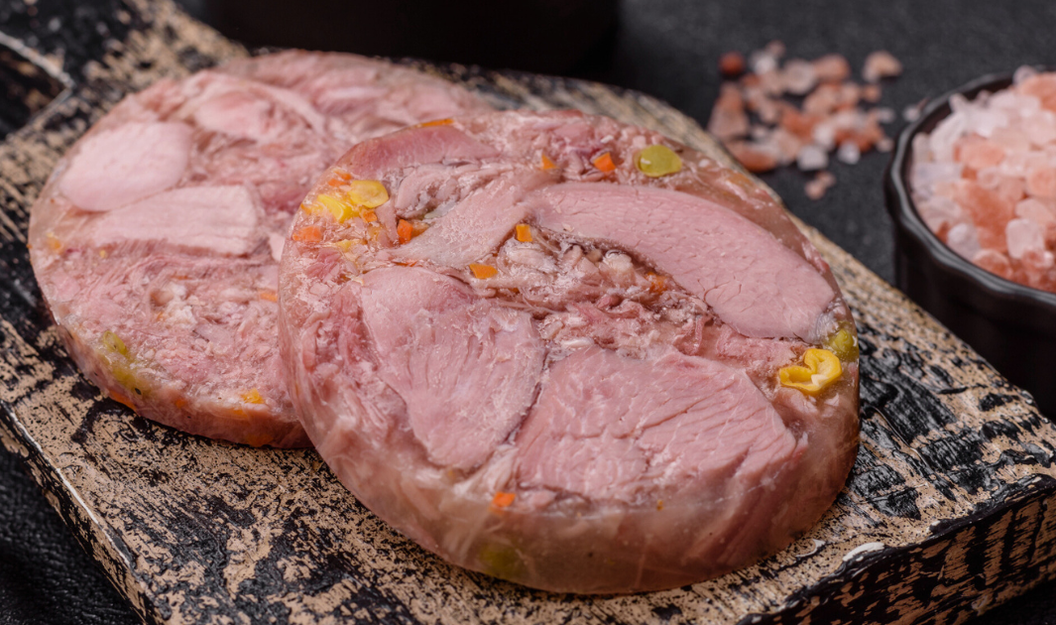
Aspic is a clear, firm jelly used as a coating, setting agent or binding agent in food. It is produced when a seasoned liquid – such as meat or fish stock, or vegetable stock – is allowed to set as it cools with the aid of a gelling agent. Aspic is mainly used in the food industry to embed various ingredients, such as meat, fish, poultry, vegetables or eggs, in the clear, firm mass. At the same time, this protects and showcases the ingredients.
Aspic protects the food it encloses from oxygen and drying out, acts as a flavour carrier for stocks and spices, and ensures a clean cut, for example in sausages. When kept consistently chilled and packaged correctly, it can help extend the shelf life.
The history and use of aspic go back a long way. It is said that as far back as ancient times, the jellies produced by boiling down collagen-rich parts of fish or meat were already being used in food. Aspic was initially particularly popular in haute cuisine, where it was especially prized for its decorative qualities when setting festive tables.
Technological progress and the industrial production of gelatine led to a wider availability of meat products, as aspic-based dishes such as jellied meat became easier to produce. Furthermore, the increasing use of refrigerators meant they could be stored more effectively.
Gelatine is the traditional ingredient in aspic – a gelling protein of animal origin derived from collagen, typically from pigs, cattle or fish. Aspic is the finished, flavourful jelly that sets as it cools.
Sülze, also known as Sulz, is the finished dish that contains aspic. There are countless variations of Sülze, which differ in terms of their ingredients and seasoning. In Sülze, the aspic is typically savoury and clear – but there is a wide variety of different Sülze dishes.
In the case of aspic, the fillings, spices and gelling mixture are specifically balanced to complement one another. The gelling mixture can be derived from the collagen in the ingredients or from added gelling agents such as gelatine. The gelling mixture ensures that the products can be easily spread onto thinly sliced bread.
As well as in brawn and sausage products, aspic is also found in Pies or as a gourmet glaze. Edible gelatine is usually used to make traditional aspic. However, modern versions may be made from plant-based thickening agents such as agar-agar or carrageenan.
To produce a successful aspic product that meets requirements such as the production process, target audience, stability and mouthfeel, the right base is just as important as the recipe.
The gelling protein derived from collagen is typically obtained from pigs, cattle or fish. It has a melt-in-the-mouth texture and gels even at moderate temperatures. Its behaviour can be controlled by varying the quality grades – such as Bloom strength – and adjusting the dosage accordingly. Strong acids can reduce its gelling ability.
This gelling agent has a very high gelling power and, due to its purely plant-based origin, is often used in vegetarian or vegan products. Agar-agar is made from seaweed. To produce clear and firm jellies, it requires very high temperatures when heated – it must be brought to the boil briefly to activate it. This has the advantage that it remains stable even at higher temperatures and explains its excellent heat stability when used in buffets or at food counters. The texture of agar-agar is less melt-in-the-mouth than that of gelatine, but the products are very firm when cut.
Carrageenan is a plant-based gelling and thickening agent derived from the polysaccharides of red algae. It is used in the production of meat and delicatessen products, for example, to form gels, bind water, ensure firmness when sliced, or create clear glazes. Some carrageenan products – such as the one available in our shop – disperse in cold water, which makes them easier to incorporate.
Which base is most suitable therefore depends on the manufacturing process, the end product, the intended use and the target audience. Whilst gelatine remains the standard ingredient in traditional aspic-based dishes such as aspic, innovative vegan alternatives are increasingly being used in other contexts.
Depending on how aspic is used and what properties the end product is intended to have, various factors may come into play during processing:
Choose the right base: The choice depends on the desired texture, the processing steps, the temperature resistance and the product properties.
Prepare the liquid correctly: When it comes to a clear appearance, a stable gel structure or uniform firmness, factors such as temperature control and the way the gel spreads must be taken into account.
Prepare the insert: To ensure that the filling behaves as it should in the aspic, it should be cut to a uniform size and brought to the same temperature before use.
Pour carefully: To ensure that air bubbles do not affect either the clarity or the cut, it helps to introduce the insert from a low height and to fill the container at a steady, even pace.
Cooling properly: The jellied products should then be brought to storage temperature quickly and evenly, but without any sudden temperature changes, as these can cause cracks or condensation.
Thinking about packaging: The type of packaging should be chosen according to how the aspic is to be used. Depending on the product, thin-walled packaging may cause breakage. Sturdier packaging provides a solution to this problem.
Whether you’re producing savoury aspic products or other high-quality food products – with us as your experienced specialist wholesaler and supply chain experts for supplies and consumables used in food production, you’re always well-equipped.


More articles